

Dive Deep into Sheaffer Pencils (and Pens)
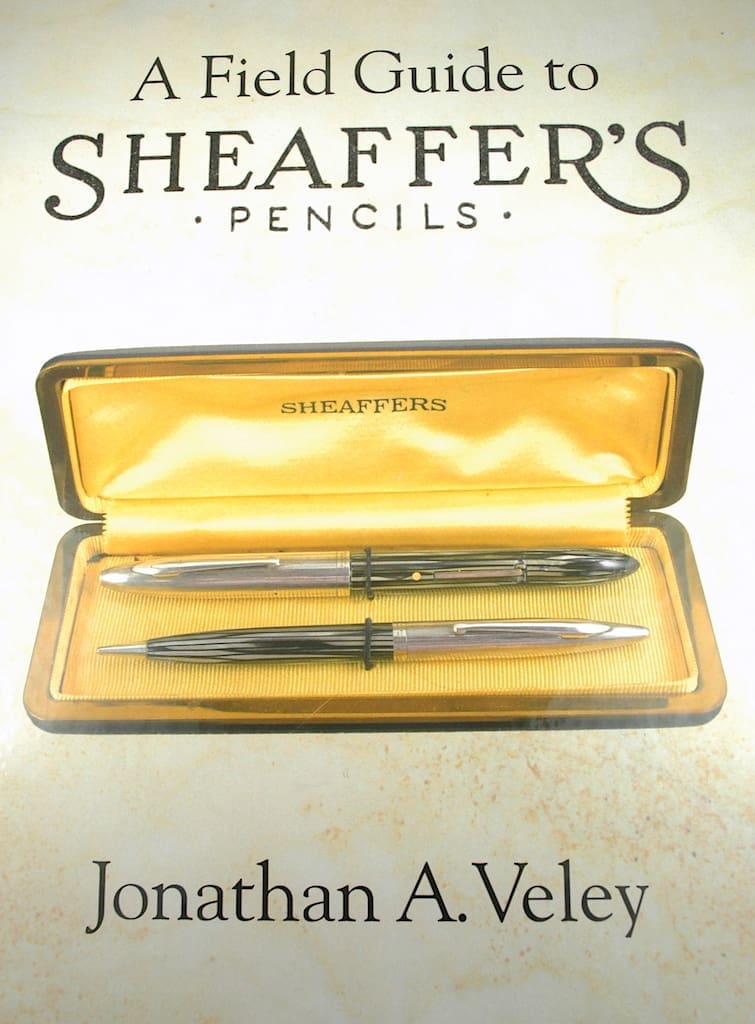
For years, I have written ad nauseam about how Sheaffer pens pulled me into the vintage pen addiction. To this day, Sheaffer writing instruments remain my general favorite. And up until 2023, there was a severe shortage of books that were deadly accurate about Sheaffer and its products. Thank goodness that was the year Jonathan Veley gave us “The Field Guide to Sheaffer Pencils.”
This book is an especially comprehensive tome about the Sheaffer company from its birth into the 1960s. Although pencils are the primary focus of the book, they evolved at Sheaffer in tandem with the pens. You will learn a little about the pens, too, if that is your primary interest.
 If you don’t know who Jonathan Veley is, he is the world’s foremost expert on American-made mechanical pencils. He’s not too shabby with his knowledge of other pencils from around the world. A lawyer in Ohio by day, he has built the most comprehensive pencil museum by night. In addition to that, he has a pencil manufacturing set up using the original Autopoint Pencil Company machinery. He sells a huge selection of every lead size, shape and color imaginable. Best of all, he is kind enough to share all of his pencil knowledge on his blog: The Leadhead’s Pencil Blog. To round out his lead-based resume, Veley has written several other books about pencil companies and their histories, as well as books detailing every American pencil patent from the 19th century to now.
On a more personal note, I’ve known Veley for nearly 15 years, having met on the Pen Show Circuit.
The Content
Nonfiction histories can take many forms. Some are very narrative driven, and others are great at showcasing the straight-forward facts. Veley’s approach is straight forward and very visually driven. Each chapter starts with a brief narrative history about the people, inventions and even legal disputes that arise from the Sheaffer Pencils in question. Then you are give a detailed tour of Veley’s (and his friends’) vast collection(s) of the models of pencils and their official advertising discussed in the chapter. On average, you get 2 or 3 pages of prose followed by 20 to 30 pages of images often featuring dozens of variations on various pencil models.
It is unlikely you will ever encounter a more comprehensive set of images to help you identify Sheaffer pencils. And not just Sheaffer pencils, but all of the pencils Sheaffer made under different names and for different companies! You will see a fair number of pens, too, but they definitely take a back seat to the pencils. He even features Sheaffer packaging, leads and store displays, which helped to promote and sell Sheaffer pencils.
Final Analysis
Veley sets expectations appropriately by designating this book as a field guide in the title. It is a masterpiece of a field guide earning 5 stars out of 5 from this reviewer. If you cannot identify a 1900s to 1960s Sheaffer pencil or Sheaffer-adjacent pencil by using this book, either the pencil you are looking at has nothing to do with Sheaffer, or Veley will gladly pay you top dollar for whatever it is you have found.
All of that said, there are some things that I wish were here but are not. Although Veley touches on Sheaffer pencils of the 1970s to now, they are given far less detail and attention. I would like to have learned more about the modern “click” mechanisms. I also would have liked more comprehensive discussion about repairing old lead-propelling mechanisms with detailed photos of the repairs in progress.
Just one more thing…
Lastly, many people reading this post are likely familiar with the books: “Parker Duofold,” “Parker Vacumatic” and “Parker 51.” It is my hope to review those books in the near future. I have read them enough to know that if you are looking for “The Field Guide to Sheaffer’s Pencils” be like those Parker books, it is not. That is neither praise nor criticism. It is simply a fact.
It is my understanding that the Parker books were written with full access to the Parker archives and with the help of surviving members of the Parker family. As such, those books are much more narrative histories detailing more about how decisions were made within the company and discussed the many people who made those legendary pens and pencils the bestsellers they were. Those books also have the same high-level of image and advertising documentation as Veley’s field guide. However, this Sheaffer book lacks the narrative thread and deeper behind-the-scenes look at the Sheaffer company.
I would gladly stand in line for Sheaffer books similar to the Parker books. In a similar break down, “Sheaffer Flattop,” “Sheaffer Balance,” “Sheaffer Vacuum-Fil,” “Sheaffer TouchDown” and “Sheaffer Snorkel” would all be epic. Yet, whereas the Parker archives and family are still fairly intact and accessible to researchers, I don’t know if anything close to that still exists for Sheaffer.
No comments found for Post ID: 24674