

Not Your Average Pen Collection
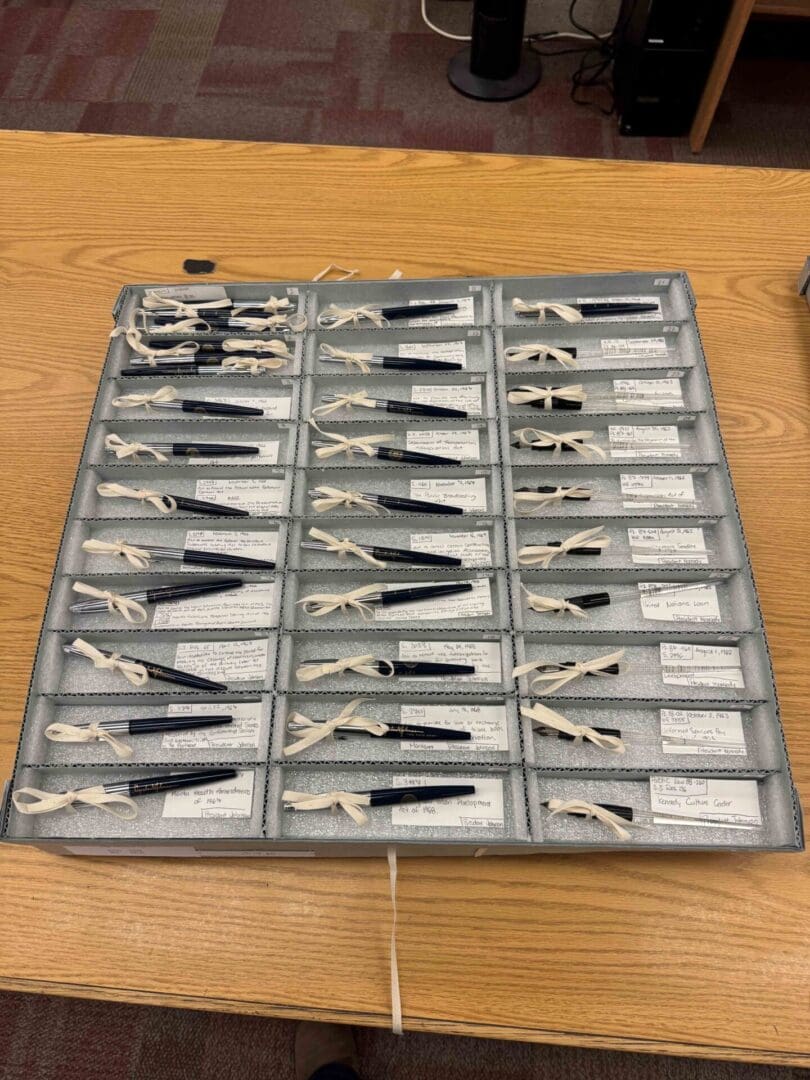

President Lyndon Johnson signed the Civil Rights Act into law using this and several other Esterbrook dip pens. After the ceremony, this pen was given to Senate Majority Leader Mike Mansfield of Montana. Photo courtesy of the Maureen and Mike Mansfield Library.
Nestled in the northern Rockies is a pen collection of profound significance. Sure, one could criticize the collection for being made of mostly cheap Esterbrooks and Parkers, but both the collectors and what these pens accomplished are what impresses.
Visit the Maureen and Mike Mansfield Library at the University of Montana, in Missoula, Montana, and you can see many of the pens that helped write the history of the mid-twentieth century into the early 2000s. These are the presidential signing pens spanning the John F. Kennedy administration to the Barack Obama administration, collected by Montana’s former U.S. senators Mike Mansfield and Max Baucus.
Until Kentucky Senator Mitch McConnell came along, Mike Mansfield was the longest serving U.S. Senate Majority Leader. Considered one of the most powerful Democratic senators in U.S. history, Mansfield led the Senate in the 1960s and ’70s, back when the two parties actually worked together and got stuff done. After Mansfield retired from the Senate, President Ronald Reagan tapped Mansfield to be the American ambassador to Japan.
Max Baucus served in the U.S. Senate from 1978 to 2014. He, too, was a Democrat and finished his career as the leader of the Senate Finance Committee, among other committee assignments. He retired from the Senate in 2014, when President Barrack Obama made him the U.S. ambassador to China.
Each Senator was influential in passing hundreds of laws.
The Mansfield Pens
As is the custom of the United States government, presidents often make gifts of the pens used to sign important pieces legislation to the Senators, Representatives and advocates who helped get the laws made.
The Maureen and Mike Mansfield Library is home to scores of these pens.
Among these pens are the ones that Johnson used to sign the Voting Rights Act and another that created Medicare. Photo courtesy of the Maureen and Mike Mansfield Library.
The most prominent models featured are Esterbrook dip pens and Parker-Eversharp felt-tip pens. The student librarian, with whom I worked to learn more about these pens, said that she was not authorized to speak on the record and asked me to leave her name out of this story.
She is, however, the primary archiver of these presidential signing pens and could share some details. All of the pens are stored with a bit of information detailing what bills they signed into law. The Esterbrook pens all use the slightly upgraded 2668 nib. Esterbrook advertised its steel 2668 nibs as “general writing” nibs.
The felt-tip pens look just like Parker 45s and/or Eversharp Challengers. Our friendly librarian said they are listed as Parker-Eversharp “Bill Signers.”
Among the pens are a pen used to sign the Civil Rights Act, the Voting Rights Act and the creation of Medicare. The pen used to create the Kennedy Center is also present.
The collection shows that the pens used by presidents John F. Kennedy and Lyndon Johnson were Esterbrook dip pens. President Johnson made the transition to the Parker-Eversharp pens, which were also used by Richard Nixon, Gerald Ford, Ronald Reagan and George H.W. Bush. Some of the earlier felt-tip pens had the Eversharp clips, but later models all had the Parker arrow clips.
The Baucus Pens

These are the Parker pens used by presidents Richard Nixon and Gerald Ford. Photo courtesy of the Maureen and Mike Mansfield Library.
In the Sen. Max Baucus archive are the Parker Bill Signers used by Presidents Ronald Reagan and George H.W. Bush. Also featured are a couple of Parker Insignia ballpoints used by President Bill Clinton and a Cross Century II rollerball used by President Barack Obama.
At the moment, none of the pens are on display. However, you can make an appointment with the Maureen and Mike Mansfield Library to view the collection any time for free. You can e-mail the library from its website: https://www.umt.edu/library/.
Leave a Comment
You must be logged in to post a comment.
02/13/2026
Neat piece of Americana. Was it yourself who wrote earlier about the pen MacArthur used to accept Japan's surrender in 1945? No? A lot of proud history here of your presidents. Thanks.
02/11/2026
Nice story, Nathaniel. Thanks. What the hell is wrong at that library? I can't imagine that a well-designed and properly promoted display of that collection in the center of the library would not attract many visitors.
02/04/2026
This is so interesting and something I have been trying to research for years. Thanks so much for sharing.