Summer’s Sunburned Inks

A year of UV light (the sun) is pretty harsh on these Sheaffer Skrip inks from the 1980s and early 2000s.
It has been a little while since we have done any ink testing. Why? We let this batch of ink tests sit in our sunniest window for a full year, instead of our usual 3 to 6 months. What a difference a year makes!
The inks we tested did not like that much UV light. All of them were severely faded at the end of one year in the sun. Some were almost invisible.
Up first are 5 Sheaffer inks. Four of the bottles were from the 1980s, with the maroon labels and classic Snorkel lip for mess-free filling. These inks were likely made in Fort Madison, Iowa, where the original factory remained in operation. One of the inks was from the early 2000s, when Sheaffer ink production moved to Slovenia. The America-made Sheaffer Skrip fared poorly in that much sunlight. The Slovenian Sheaffer Skrip ink started as black and remained legible, though turned a dark brown.
As we like to pH test our inks, we calibrated our tester before getting started. The results were interesting. However, before we reveal those results, let us remind you that these numbers are strictly data points. As we don’t know the ingredients of the inks, these numbers do not guarantee any particular results, as we don’t know how those ingredients will interact with the ingredients making a rubber ink sac, converter or internal pen parts. As a quick reminder, water has a pH value of 7, which is completely neutral. The closer something gets to 0 the more acidic it is. The base or alkali side of the spectrum tops out at 14. It is important to note that our results might vary, as we only tested a single bottle of each color.
Ink Color pH
’80s Red 5.4
’80s Green 3.2
’80s Blue 3.6
’80s Grey 7.5
Slovenian Black 8.2

PenMan, Omas, J. Herbin and Aurora inks get additional testing to see how light fast they are while also getting pH tested.
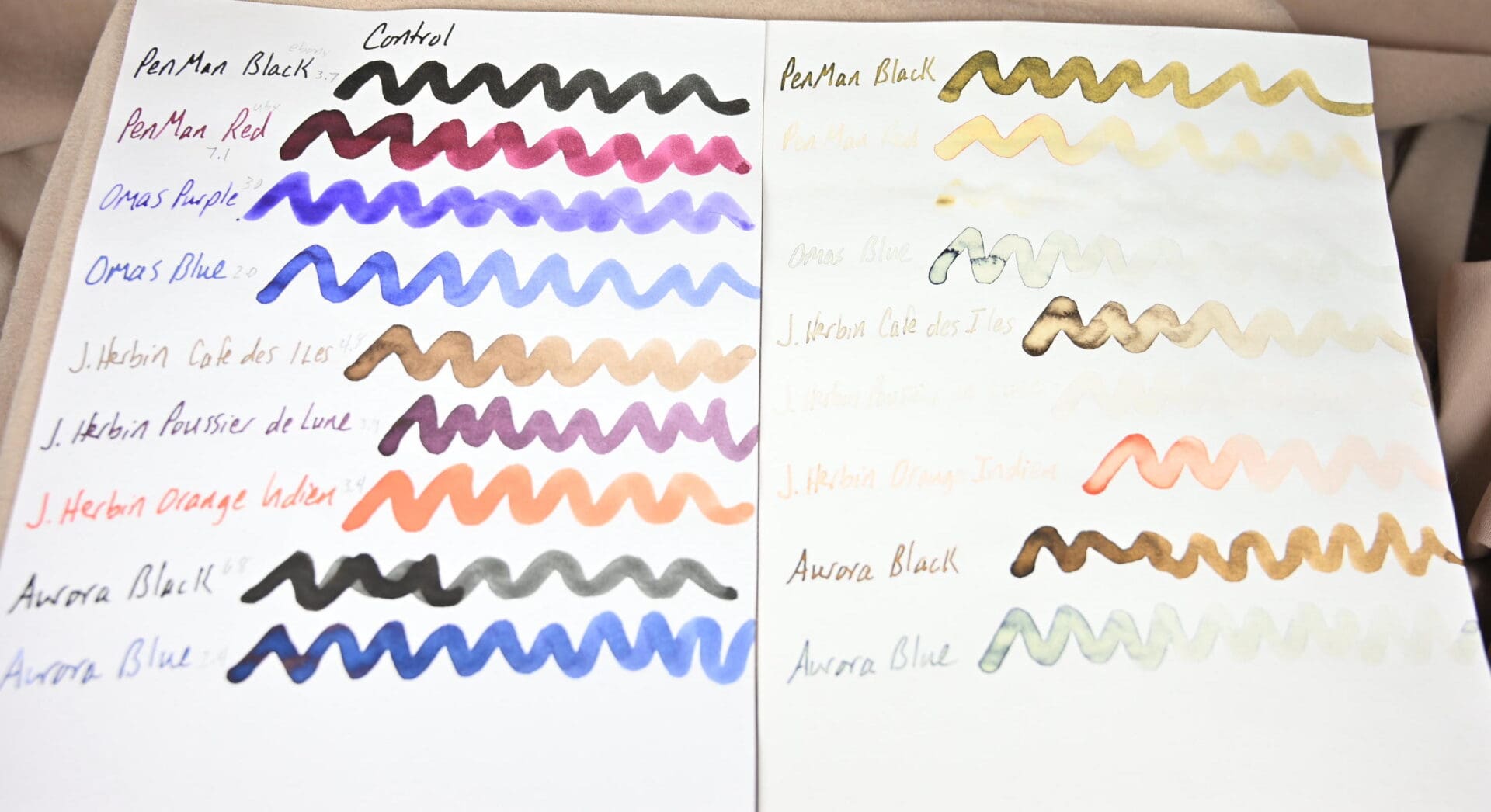
For our second batch of inks that faced a year of direct sunlight, we have random samplings of Parker PenMan, Omas, J. Herbin and Aurora. For as attractive as they are, these inks did not fare well, either. PenMan Black, which is no longer made, and Aurora black held out okay, though they turned brown. Aurora blue put up a good fight and remained maybe 25% visible, where laid down thick. J. Herbin’s Cafe des Iles remained fairly legible, too.
The pH test also proved interesting. The black PenMan ink, Omas blue ink, Omas purple and Aurora blue ink were very acidic at 3.7, 2.0, 3.0 and 2.4, respectively. Oddly enough, PenMan red, which is more like a deep burgundy in our trial bottle, and Aurora black were nearly pH neutral at 7.1 and 6.8, respectively. Again, we don’t know how their ingredients would work on or against rubber ink sacs and converters, but we still find these data points interesting.
Ink Color pH
PenMan Black 3.7
PenMan Red 7.1
Omas Purple 3.0
Omas Blue 2.0
J. Herbin Cafe des Iles 4.8
J. Herbin Poussier de Lune 3.9
J. Herbin Orange Indien 3.4
Aurora Black 6.8
Aurora Blue 2.4
No comments found for Post ID: 26355